
Shuffleboard Knock Off Game Rules
Knock Off Shuffleboard Game Rules
1. Basic Overview
2. How to Play
3. How to Score
4. Scoring Examples
5. Miscellaneous Rules
Basic Overview:
Games are played one-on-one or with two teams of two people. Team members play at opposite ends of the board and remain there for the duration of the game. Games are played until one team scores 15 points at which time they are declared the winners. Weights are considered in play if they are on the board and past the foul line closest to the shooter (i.e., a short foul line).
How to Play:
Initial shooting and weight color are decided by coin flip. The winner of the flip may elect to choose the "color" or the "hammer". The hammer is the last weight shot in a round (i.e., the other team shoots first). It is considered advantageous to have the hammer. When color and shooting order are decided play begins.
The team without the hammer shoots first. The other team shoots second. Players continue to alternate shooting until all weights are used. At this time, points are counted and play continues from the opposite end. The team which scored points on the previous round must shoot first on the next round. If no points are scored on the preceding round (e.g., all weights are knocked off) than the hammer changes. In other words, the team that had the hammer during the round where no points were scored must shoot first the next round. Play continues in this manner until on team reaches 15 points.
How to Score:
Only one team scores in a round.
The team which has their weight closest to the end of the board scores. All of their weights which are ahead of their opponent's deepest weight (closest to the end of the board) are added together for the score for that round.
A weight scores one point if it is located between the short foul line (short foul line) and the "2" line.
Weights completely across the "2" or "3" line count 2-points or 3-points respectively. To judge if a weight is completely over the line it should be viewed from above (i.e., look down over the top of the weight. Again the entire weight must be over the line for it to count as the next higher point value. You should be able to see some wood between the line and the weight.
If any portion of the weight is hanging over the end of the board (not the side) it is called a "hanger" and counts four (4) points. Close calls can be checked by holding a weight so the bottom of the weight is along the back end of the board. The weight is then slid along the back end of the board. If it hits the "disputed" hanger the weight is indeed hanging and is worth 4 points.
Scoring Examples:
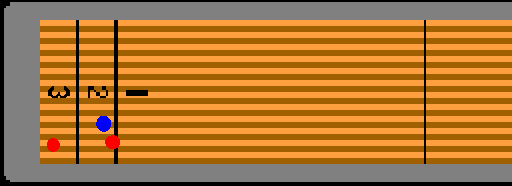
On the table above, the "red" team gets to score because the red weight is closest to the end of the board. All red weights located between the end of the board and the first blue weight would be added up for a total score. On the table above, there is only one red weight between the end of the table and the first blue weight, so only one weight counts for points. It appears that this weight is a three (3). Thus the red team scores three points.
If a second red weight was ahead of the blue weight, it to would be added into the score. That is, there would be two red weights located between the end of the table and the first blue weight. The red team would than get the combined point value of both weights.
If the red weight in the 3 area was not there, the blue team would score (2) since the blue weight is ahead of the other red weight and also across the 2 line.
If all weights on the board are the same color they all count. All point values are added for the team with their weights on the board.
Miscellaneous rules:
Before a player shoots, the player can dust the board if dry spots are showing.
Note: In tournaments this may be restricted to the edge of the board.
Shooters must have one foot behind the playing surface while they are shooting.
Hitting or shaking the table is never allowed.